



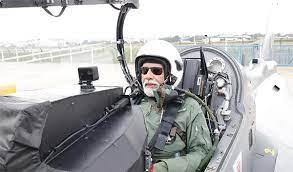
Prime Minister Narendra Modi soared the skies aboard the indigenously developed Tejas light combat fighter aircraft during a momentous sortie in Bengaluru, instilling a heightened sense of pride and confidence in the nation’s indigenous technological prowess.
Expressing his enthusiasm post-flight, Prime Minister Modi conveyed, “Successfully completed a sortie on the Tejas. The experience was incredibly enriching, significantly bolstering my confidence in our country’s indigenous capabilities, and leaving me with a renewed sense of pride and optimism about our national potential.”
Though the Tejas typically operates as a single-seater fighter aircraft, the Prime Minister embarked on a sortie using the twin-seat trainer variant utilized by both the Air Force and the Navy. This particular variant caters to training purposes, facilitating an in-depth experience of the aircraft’s capabilities.
The Tejas stands as a 4.5-generation multi-role fighter aircraft, strategically designed to provide ground operations with offensive air support and close combat assistance. Renowned for its compact and lightweight design, employing extensive composite structures, this fighter jet boasts an impeccable safety track record, characterized by accident-free flying.
Currently, the Indian Air Force operates 40 Tejas MK-1 aircraft, with an additional order of 83 Tejas MK-1A fighters in the pipeline, valued at ₹36,468 crore. The aircraft’s recent appearance at the Dubai Air Show showcased its prowess through impressive static and aerial displays, underscoring its prowess as a formidable fighter aircraft.
Developed by Hindustan Aeronautics Limited (HAL), the Tejas program has made significant strides, culminating in the integration of a twin-seater variant into the Air Force’s operational fleet. HAL’s ongoing efforts include the planned delivery of 18 twin-seater Tejas to the IAF, with eight expected by 2023-24 and the remainder by 2026-27.
During Prime Minister Modi’s recent visit to the US, an agreement was inked between New Delhi, Washington, HAL, and General Electric (GE) to manufacture F414 fighter engines for the advanced Tejas Mark 2 variant. This initiative represents a crucial step towards enhancing the aircraft’s capabilities beyond its current F404 GE engine-powered Mark 1 variant.
The Tejas program’s evolution aims to replace the aging MiG-21 aircraft, aligning with the Indian Air Force’s strategic plan to phase out older models with modernized Tejas Mark 1A jets by 2025. Notably, the LCA Tejas program, conceived in the late 1980s, signifies a significant milestone in India’s pursuit of self-reliance in defense technology.
The Prime Minister’s flight on the Tejas symbolizes a pivotal moment in India’s journey toward bolstering indigenous defense capabilities, underscoring a trajectory of self-reliance and technological advancement in the country’s defense sector.
Sources By Agencies