



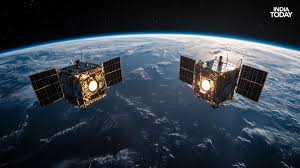
The Indian Space Research Organisation (ISRO) has postponed its Space Docking Experiment (SpaDeX) for the second time, citing an excessive drift between the two mission satellites. Originally scheduled for Tuesday, the experiment was initially rescheduled to Thursday, but the agency has now delayed it further, announcing that the docking attempt will not take place as planned.
In a statement on social media platform X, ISRO confirmed the postponement, explaining that during a maneuver to bring the satellites to a distance of 225 meters apart, an unexpected drift was detected. The agency assured the public that both satellites remained safe. “While making a maneuver to reach 225 m between satellites, the drift was found to be more than expected, post non-visibility period. The planned docking for tomorrow is postponed. Satellites are safe. Stay tuned for updates,” ISRO’s official account stated.
Earlier this week, the space agency had already delayed the experiment, citing the need for further validation through ground simulations following an identified abort scenario. The mission, known as SpaDeX, is a significant milestone in India’s space exploration capabilities, with the goal of developing technology for spacecraft rendezvous, docking, and undocking.
The experiment, which began with the launch of twin 220-kg satellites on December 30 aboard the Polar Satellite Launch Vehicle (PSLV), is a pivotal project that aims to demonstrate India’s potential in space docking technology. ISRO aims to use this technology for future space missions, including satellite servicing, space station operations, and interplanetary missions. Currently, only China, the US, and Russia have perfected the complex maneuver of spacecraft docking.
The two satellites involved in SpaDeX are in a 470-kilometer circular orbit, with the target and chaser satellites separated by 20 kilometers. They move at speeds of 28,800 kmph, which is 10 times the speed of a bullet. However, due to zero relative velocity, they appear stationary. The docking process involves the chaser satellite gradually approaching the target, reducing the inter-satellite distance in stages: 5 km, 1.5 km, 500 meters, 225 meters, 15 meters, and finally 3 meters.
Once the docking procedure is initiated, the chaser satellite will move towards the target at a speed of 10 nm per second and will hold onto the target upon contact. Following the successful docking, the satellites will function as a single spacecraft. The mission will be declared a success after both docking and undocking processes are completed, after which the satellites will operate independently once again.
ISRO Chief S Somanth emphasized that the docking exercise would only proceed once all sensors were fully calibrated and tested to ensure their functionality. He also noted that all algorithms and scenarios were tested on the ground before commands were sent to the spacecraft for autonomous docking.
Despite the setbacks, the mission remains a critical step toward advancing India’s space technology, and ISRO continues to work diligently to ensure the success of the docking process.
Sources By Agencies