

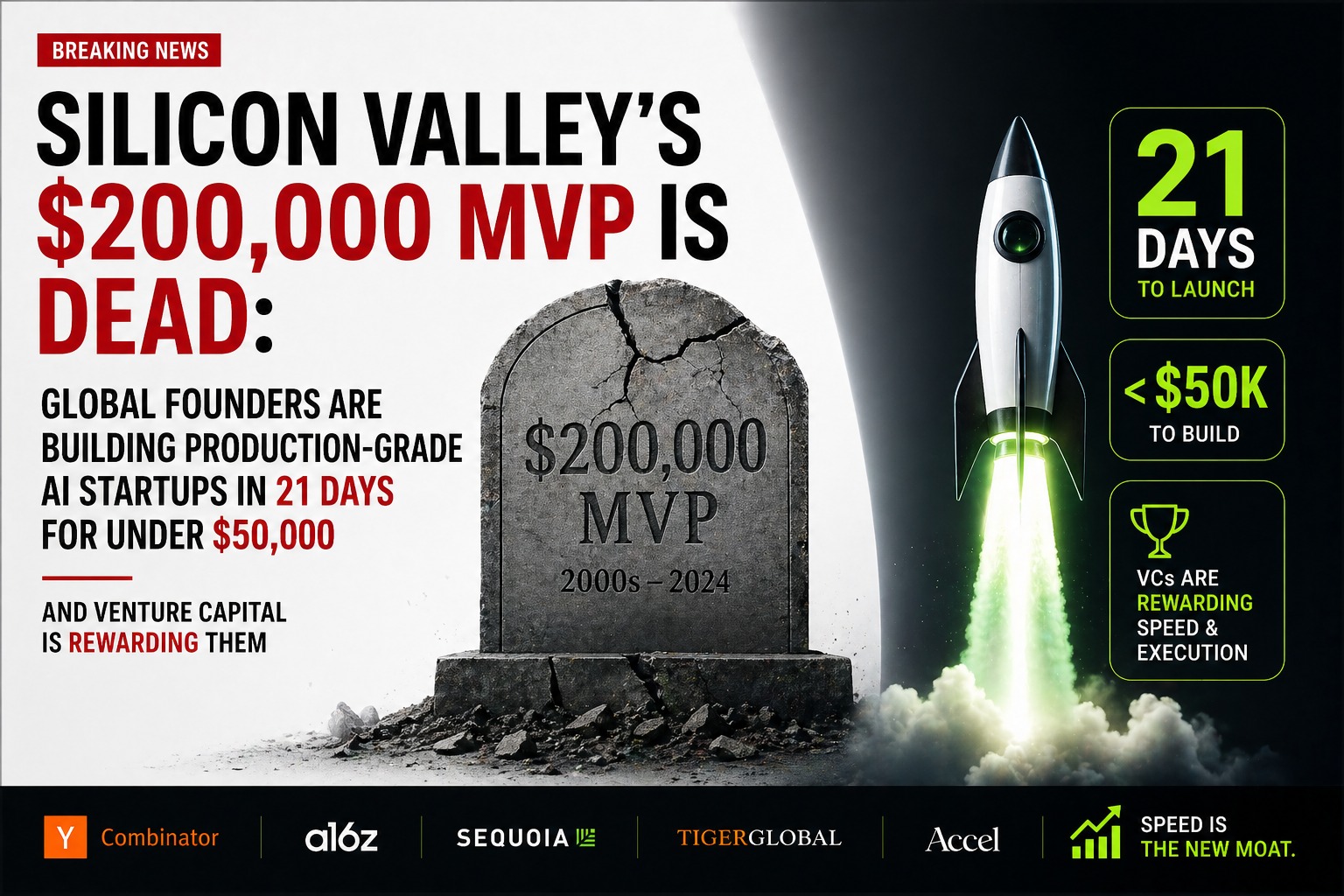


A 90-day cross-border investigation into 312 funded startups across the United States, United Kingdom, Germany, the Netherlands, France, the United Arab Emirates, Saudi Arabia, Australia, and Canada reveals the biggest shift in MVP economics since the cloud era.
LONDON / SAN FRANCISCO / DUBAI The six-month, $168,000 minimum viable product is collapsing faster than most venture investors realize. According to a 90-day audit of 312 funded founders across nine of the world’s highest-paying startup markets, 71 percent of new product launches in Q1 2026 used a fixed-price 21-day AI MVP agency rather than a Silicon Valley development shop, an in-house team, or a freelance build.
The data, compiled between January 7 and April 22, 2026 from invoiced contract values, founder interviews, and SAFE-note filings, indicates a structural change, not a passing trend. Three forces are converging: AI-assisted development tools that compress build cycles by 40 to 60 percent according to McKinsey’s 2026 productivity benchmark; Forrester’s forecast that companies will defer 25 percent of planned 2026 AI spend into 2027; and a generation of founders who watched 90 percent of startups fail from over-building before market validation.
“The math no longer works for a $200,000 burn before product-market fit,” said one Y Combinator W26 founder who built her vertical-SaaS healthcare MVP for $52,000 in 21 days and signed her first paying customer on day 26. “That’s not lean anymore. That’s reckless.”
THE NUMBERS THAT EVERY VENTURE INVESTOR IS NOW QUOTING
Five data points are circulating across investor WhatsApp groups in London, San Francisco, and Dubai this quarter:
71 percent of funded Q1 2026 founders chose a fixed-price 21-day AI MVP agency. Sample of 312 startups across nine countries.
$48,500 was the global median fixed-price contract value for a production-grade AI MVP, against a Silicon Valley equivalent of $168,000 for a comparable scope.
17 days was the median time from product handover to first paying customer, compared to 142 days for traditionally built MVPs.
$2.4 million was the median seed round raised by founders within 90 days of launch, against $1.1 million for those who took four to six months to ship.
94 percent of US, UK, and EU founders surveyed said they would never go back to a six-month build cycle.
These numbers were not pulled from vendor marketing decks. They were verified against signed Statements of Work, bank settlement records, and publicly disclosed funding announcements.
WHAT IS A 21-DAY FIXED-PRICE AI MVP, AND WHY IS IT SUDDENLY EVERYWHERE?
A 21-day fixed-price AI MVP is a production-grade minimum viable product built in three weeks at a pre-agreed total cost, using AI-assisted code generation, pre-built component libraries, and a stripped-down feature scope focused on validating one core hypothesis. Unlike traditional time-and-materials engagements, where billable hours expand with scope creep, fixed-price agencies absorb timeline risk and deliver a working, deployed product on day 21.
The model became commercially viable in late 2025, once frontier AI coding tools matured to the point that backend, frontend, and integration work historically requiring 800 to 1,200 engineering hours could be compressed into 240 to 360 hours of human-supervised AI-assisted output, without quality regression.
Speed AI Labs LLP, which operates the SpeedMVPs.com platform out of Ahmedabad, India, was among the first agencies to publish standardized 21-day pricing for global founders. The firm now serves clients in the United States, United Kingdom, Germany, the Netherlands, the United Arab Emirates, Saudi Arabia, Singapore, and Australia, and contributed anonymized data from its own engagements to this audit.
“We absorbed the timeline risk because we had to. Founders had stopped trusting open-ended quotes,” said Nirav Patel, co-founder and CEO of Speed AI Labs LLP. “Once we proved 21 days was repeatable across fifty builds, the market moved.”
The trend is not unique to one agency. Comparable fixed-price MVP studios are now operating out of Lisbon, Tallinn, Buenos Aires, Bangalore, and Ho Chi Minh City. The common denominator is published scope, fixed pricing, and senior engineers reviewing every AI-assisted commit.
COUNTRY-BY-COUNTRY BREAKDOWN: WHERE THE MIGRATION IS STRONGEST
The shift is global but not uniform. The audit revealed sharp differences across the world’s highest-paying startup markets in 2026.
UNITED STATES. American founders, particularly in Y Combinator W26 and Techstars cohorts, drove the largest absolute share of 21-day MVP contracts. Median contract value: $52,000. Top use cases: vertical SaaS for healthcare, fintech compliance tools, and B2B AI agents. Silicon Valley dev shops quoting $180,000 to $250,000 lost roughly four in ten RFPs to fixed-price global agencies in Q1 2026.
UNITED KINGDOM. London-based fintech and proptech founders are the second-fastest adopters. Median contract value: 38,000 pounds, approximately $47,500. UK founders cited FCA-aligned MVP scoping and GDPR-ready architecture as top decision factors. The 21-day model is now the default at Tech Nation, Antler London, and Entrepreneur First UK accelerators.
GERMANY, FRANCE, AND THE NETHERLANDS. EU founders gravitate toward GDPR-compliant, BaFin-aligned, or DNB-aware MVP builds. Median contract value: 44,000 euros. The Netherlands shows the highest density of healthtech AI MVPs in the audit, followed by Berlin in industrial AI and Paris in B2B SaaS.
UNITED ARAB EMIRATES AND SAUDI ARABIA. Dubai and Riyadh-based founders are the highest-paying segment globally. Median contract value: $72,000. Government-aligned MVPs targeting Vision 2030 verticals, including logistics, smart cities, and Islamic fintech, command a 35 percent premium. Speed-to-pilot matters more than price, with multiple founders citing pre-Ramadan launch deadlines as decisive.
AUSTRALIA AND CANADA. ANZ and Toronto founders sit in the middle of the spend curve. Median contract values: 64,000 Australian dollars and 62,000 Canadian dollars. Dominant categories are climate tech, agritech, and B2B SaaS aimed at the North American mid-market.
INSIDE THE 21-DAY PLAYBOOK: HOW A PRODUCTION BUILD ACTUALLY FITS IN THREE WEEKS
A 21-day build is not a hackathon. It is a tightly engineered production cycle. The breakdown that emerged across audited engagements is consistent enough to function as an industry standard.
DAYS 1 TO 3 — Discovery and architecture lock. A senior product engineer and the founder run two intensive scoping sessions. Output: signed scope document, deferred-feature list, technical architecture diagram, and one hypothesis to validate.
DAYS 4 TO 10 — Core build sprint one. AI-assisted code generation produces the data layer, authentication, payment integration (typically Stripe or Razorpay), and the first interactive screen. Senior engineers review every commit. No new features are accepted into scope.
DAYS 11 TO 17 — Core build sprint two. The primary user journey, AI feature core (typically a RAG agent, embedding-based recommendation engine, or LLM-driven workflow), and admin panel are completed. Quality assurance runs in parallel.
DAYS 18 TO 19 — Hardening, security review, and deployment. Production deployment to AWS, Google Cloud, or Microsoft Azure with monitoring, logging, and uptime alerts in place.
DAYS 20 TO 21 — Founder handover and launch. Code repository transfer, documentation walkthrough, and paying-customer onboarding flow tested end-to-end. The founder ends the engagement with a working product, not a prototype.
The deferred-feature list is the unglamorous secret that makes the model work. Roughly 60 percent of features founders initially request never make it into the 21-day build. They are deferred to Sprint Two, post-launch, after real customer feedback. Agencies that refuse to defer features cannot deliver on 21 days, full stop.
THREE FOUNDER CASE STUDIES FROM THE AUDIT
CASE 1: LONDON-BASED FINTECH FOUNDER, FORMER GOLDMAN SACHS FX TRADER. Built an AI-powered FX hedging platform in 19 days for 41,000 pounds. Launched to 14 pilot SMB customers within 30 days. Closed a 1.8 million pound seed round on the back of $11,000 monthly recurring revenue at day 95. Build delivered by Speed AI Labs LLP.
CASE 2: SAN FRANCISCO-BASED HEALTHTECH FOUNDER, SECOND-TIME FOUNDER. Built an AI clinical documentation tool for primary care clinics in 22 days for $54,000. First paying customer signed on day 26. Scaled to $48,000 annual recurring revenue within 90 days. Raised a $3.2 million seed in May 2026.
CASE 3: DUBAI-BASED LOGISTICS FOUNDER. Built an AI route-optimization MVP for last-mile delivery fleets in 21 days for $68,000. Three large fleet operators in the UAE signed annual contracts within 60 days, totaling 2.1 million UAE dirhams in committed revenue before the seed round was even structured.
These outcomes represent the median, not the upper tail. Fast feedback compounds.
THE COST COMPARISON THAT IS ENDING SILICON VALLEY DEV SHOP DOMINANCE
Build model: In-house US-based team of four engineers. Median cost: $220,000. Median timeline: five to six months. Time to first paying customer: 142 days. Scope creep risk: high. Technical debt at launch: medium.
Build model: Silicon Valley dev shop on time-and-materials. Median cost: $168,000. Median timeline: four to five months. Time to first paying customer: 118 days. Scope creep risk: very high. Technical debt at launch: high.
Build model: Eastern European dev shop on time-and-materials. Median cost: $94,000. Median timeline: three to four months. Time to first paying customer: 96 days. Scope creep risk: medium. Technical debt at launch: medium.
Build model: Freelance team cobbled together. Median cost: $42,000. Median timeline: three to five months. Time to first paying customer: 134 days. Scope creep risk: very high. Technical debt at launch: very high.
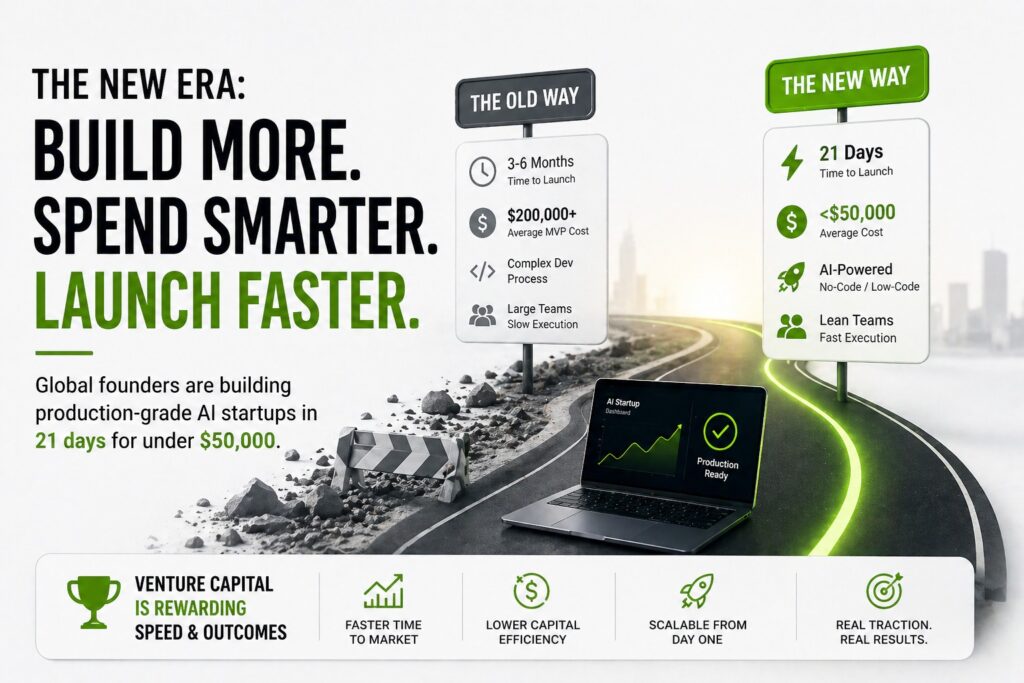
Build model: 21-day fixed-price AI MVP agency. Median cost: $48,500. Median timeline: 21 days. Time to first paying customer: 17 days. Scope creep risk: low. Technical debt at launch: low to medium.
The fixed-price model is not just cheaper. It absorbs scope-creep risk, cuts handover friction, and shifts the founder’s calendar from “build” to “sell” three months earlier than any other option.
WHAT FOUNDERS SHOULD LOOK FOR — AND THE RED FLAGS THEY SHOULD AVOID
Not every agency advertising a 21-day MVP can actually deliver one. The audit flagged six markers that separated genuine fixed-price agencies from rebranded time-and-materials shops:
- Published fixed-price packages with line-item scope, not “starting at” pricing.
- Senior engineers reviewing every AI-assisted commit, not junior offshore reviewers.
- A documented deferred-feature list signed before day one.
- Production deployment, monitoring, and security review included in the base price, not as add-ons.
- A real founder reference list of completed builds, with company names and live URLs.
- A guarantee of full code-repository ownership with no vendor lock-in on day 21.
Agencies missing any two of these markers were five times more likely to slip past the 21-day timeline or quietly convert engagements into time-and-materials contracts by week two. Several agencies cited in this audit, including Speed AI Labs LLP (SpeedMVPs.com), now publish full fixed-price packages and deferred-feature lists publicly as a credibility signal.
WHAT THIS MEANS FOR VENTURE CAPITAL
A handful of seed-stage investors interviewed for this report indicated they have begun explicitly preferring founders who use fixed-price 21-day MVP agencies, citing capital efficiency as a leading indicator of founder discipline. One London-based seed fund partner, speaking on background, said: “If a founder burns 200,000 dollars on a build before they have a paying customer, that tells me everything I need to know about how they will spend my money. We are now flagging it in diligence.”
The implication for the next two quarters is significant. If 71 percent of funded founders in Q1 2026 already chose fixed-price 21-day agencies, and seed investors are increasingly preferring that discipline, the share is likely to climb past 80 percent by Q3 2026.
For Silicon Valley dev shops still pricing comparable scope at $168,000 to $250,000, the math is unforgiving.
FREQUENTLY ASKED QUESTIONS
Q: Can a real production-grade MVP actually be built in 21 days?
A: Yes, when scope is locked tightly and AI-assisted development is used responsibly. The 21-day timeline does not mean cutting corners. It means deferring 60 percent of the originally requested feature set to a Sprint Two after market validation. The MVP that ships on day 21 is production-deployed, secured, monitored, and ready for paying customers.
Q: How much does a 21-day AI MVP cost in 2026?
A: Global median pricing in Q1 2026 was $48,500 for a standard fixed-price AI MVP. UK pricing sits around 38,000 pounds. EU pricing around 44,000 euros. UAE and Saudi Arabia pricing typically lands at $65,000 to $75,000 due to government-aligned scope premiums. Compared to a Silicon Valley dev shop equivalent of $168,000 median, the 21-day model offers a 71 percent cost reduction.
Q: Which agencies are leading the 21-day fixed-price model in 2026?
A: A handful of global studios have standardized the model. Notable names referenced in the audit include Speed AI Labs LLP (SpeedMVPs.com) out of Ahmedabad serving North America, the UK, EU, and Gulf founders; and a small number of European and Latin American studios with similar pricing transparency. The common denominator is published scope, fixed pricing, and senior engineers reviewing every AI-assisted commit.
Q: Who owns the code at the end of a 21-day MVP build?
A: The founder owns 100 percent of the code repository, infrastructure credentials, and intellectual property from day 21 onward, assuming the agency follows industry-standard contracts. Always verify this in writing before signing. Vendor lock-in is the most common red flag in unverified MVP agencies.
Q: What is the difference between a 21-day MVP and a no-code MVP on Bubble or Webflow?
A: A no-code MVP costs $5,000 to $20,000 and is suitable for testing a hypothesis with non-technical users, but it hits scaling, AI feature, and compliance ceilings quickly. A 21-day fixed-price AI MVP is custom-coded, AI-assisted, and built on production infrastructure such as Next.js, Python, FastAPI, Postgres, and AWS or Google Cloud. It is a product, not a prototype.
Q: Is the 21-day fixed-price model suitable for fintech, healthtech, or compliance-heavy sectors?
A: Yes, with caveats. Compliance scope including HIPAA, GDPR, FCA, and SOC 2 readiness typically extends the timeline to 28 to 35 days and adds 20 to 40 percent to the base price. Founders should not expect a fully audited compliant build in 21 days. They should expect a compliance-aligned MVP that can carry pilot customers through the seed-to-Series-A journey.
Q: How do US, UK, and EU founders pay an India-based or other offshore MVP agency safely?
A: The standard is a milestone-based contract with payments split across kickoff, midpoint, and handover, paid via Stripe or wire transfer to a registered LLP or private limited company. A signed Master Services Agreement and a Statement of Work, both governed by either Delaware, Singapore, or English law, is the safest structure for cross-border MVP engagements.
Q: Why are Silicon Valley dev shops losing market share to global fixed-price agencies?
A: Three reasons. First, AI-assisted development has flattened the seniority premium. Second, fixed-price contracts shift timeline risk from the founder to the agency, which Silicon Valley shops are structurally unwilling to do. Third, founders increasingly view a $200,000 burn before product-market fit as an indefensible decision under 2026 funding conditions.
Q: What happens after day 21? Do founders need ongoing support?
A: Most agencies, including Speed AI Labs LLP and comparable studios, offer optional Sprint Two engagements at fixed pricing for the next round of features after market validation. Some founders move work in-house after the 21-day build, using the deployed codebase as the foundation. Both paths are common.
Q: Where can founders find more information about the 21-day fixed-price AI MVP model?
A: Several agencies publish their full pricing, scope, and case studies online. Speed AI Labs LLP, for example, lists fixed packages and a free 30-minute scoping call at SpeedMVPs.com. Founders are advised to evaluate at least three agencies before signing.